
If you run a small business, you have probably had at least one email promising “page one on Google in 30 days.” You may also have heard that SEO is too slow, too technical, or too expensive for a company your size. The truth sits somewhere in the middle. Good SEO services for small business can bring in steady, high-intent leads, but only if you know what you are paying for and how to judge the people doing the work.
This guide walks through what professional SEO services actually include, what they tend to cost, the questions worth asking before you sign anything, and the warning signs that should make you walk away. It is written for owners and marketing leads who want to make a clear decision, not for SEO specialists.
Key takeaways
- SEO services for small business work best when they target specific, high-intent searches rather than broad, competitive terms.
- Monthly retainers are the most common pricing model; a survey of 439 providers put the US median at $1,501 to $2,000 a month.
- Judge providers on transparency, ownership of your accounts, and how they measure leads, not on ranking promises.
- Clear, well-structured pages help you show up in both Google and AI-generated answers.
What are SEO services for small business?
SEO services for small business are the ongoing work of making your website easier to find, understand, and trust for people searching for what you offer, usually in a specific area or niche. Instead of competing with national brands for broad terms, a small business usually focuses on specific, local, or problem-based searches where buyers are ready to act.
In practice, most professional SEO work falls into a handful of areas:
- Technical health: making sure search engines can crawl and index your pages, the site loads quickly, and it works well on mobile.
- Keyword and intent research: finding the words your customers actually use, and separating “just looking” searches from “ready to buy” searches.
- On-page optimization: page titles, meta descriptions, headings, internal links, and content that clearly answers the searcher’s question.
- Content: service pages, guides, and blog posts that answer real customer questions. Our content marketing service covers this side, from strategic blogging and infographics to SEO-optimized and B2B writing.
- Local SEO: Google Business Profile, consistent business details across directories, and location-specific pages.
- Measurement: tracking rankings, organic traffic, and, most importantly, the enquiries and sales that come from search.
Why SEO works well for lead generation
Most marketing channels interrupt people. SEO is different because the person is already searching for an answer. Someone typing “emergency plumber near me” or “CRM consultant for a small team” has a need right now. That is why SEO for lead generation tends to bring in enquiries that are further along in the buying process than, say, a social media ad seen while scrolling.
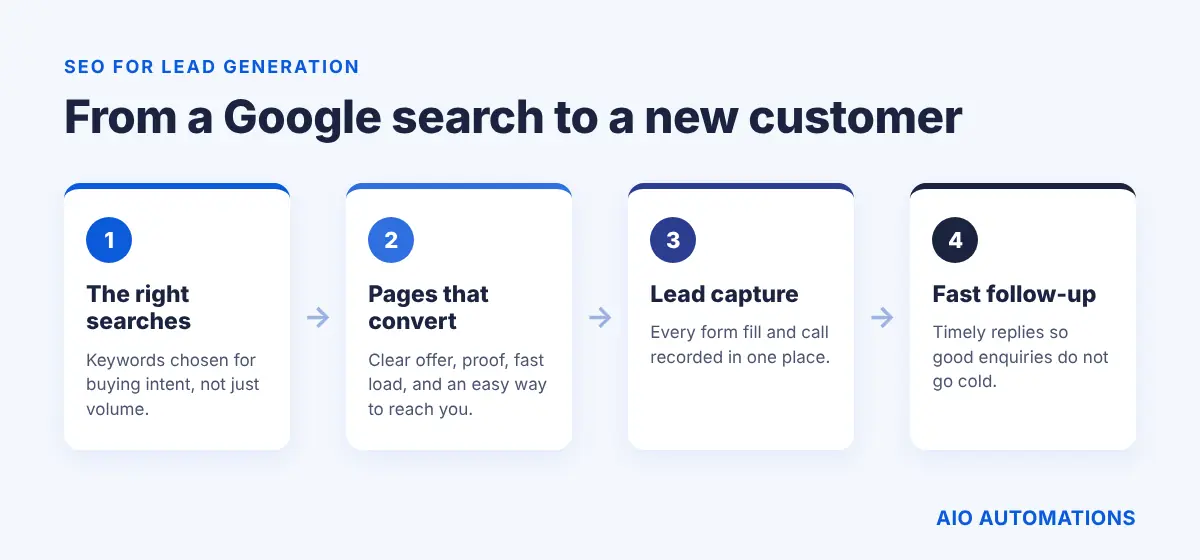
The catch is that traffic on its own does not pay the bills. A good SEO lead generation strategy connects three things:
- The right searches, chosen for buying intent rather than raw volume.
- Pages that convert, with a clear offer, proof, and an easy way to get in touch. A slow or confusing site will waste good traffic. Our website design and development team builds responsive, SEO-friendly sites using a mobile-first approach.
- A system that catches the lead, so every form fill or call is recorded and followed up. A lead management system captures enquiries from your website, scores them, and moves them into a sales pipeline, so you can see which pages actually produce customers. We build these on Zoho Forms, Zoho SalesIQ and Zoho CRM. Automated email marketing, such as follow-up and nurture sequences, can then keep those leads engaged.
If you want a deeper look at that last step, our article on AI automation for lead management and customer engagement explains how automation helps speed up follow-ups and reduce manual work, and this piece on how CRM integrations improve lead management explains how to connect your website forms to your sales process.
Is your website turning searches into enquiries?
Not getting found on Google? Request a free SEO audit from our team to see where your website stands today.
Get a Free SEO AuditHow much do SEO services for small business cost?
There is no fixed price for SEO, but monthly retainers are the most common model. In an Ahrefs pricing survey of 439 SEO providers, the median monthly retainer in the United States was $1,501 to $2,000, and agencies typically charged several times more than freelancers. Your own quote will depend on how competitive your market is, how many locations you serve, the state of your website, and how much content needs to be produced.
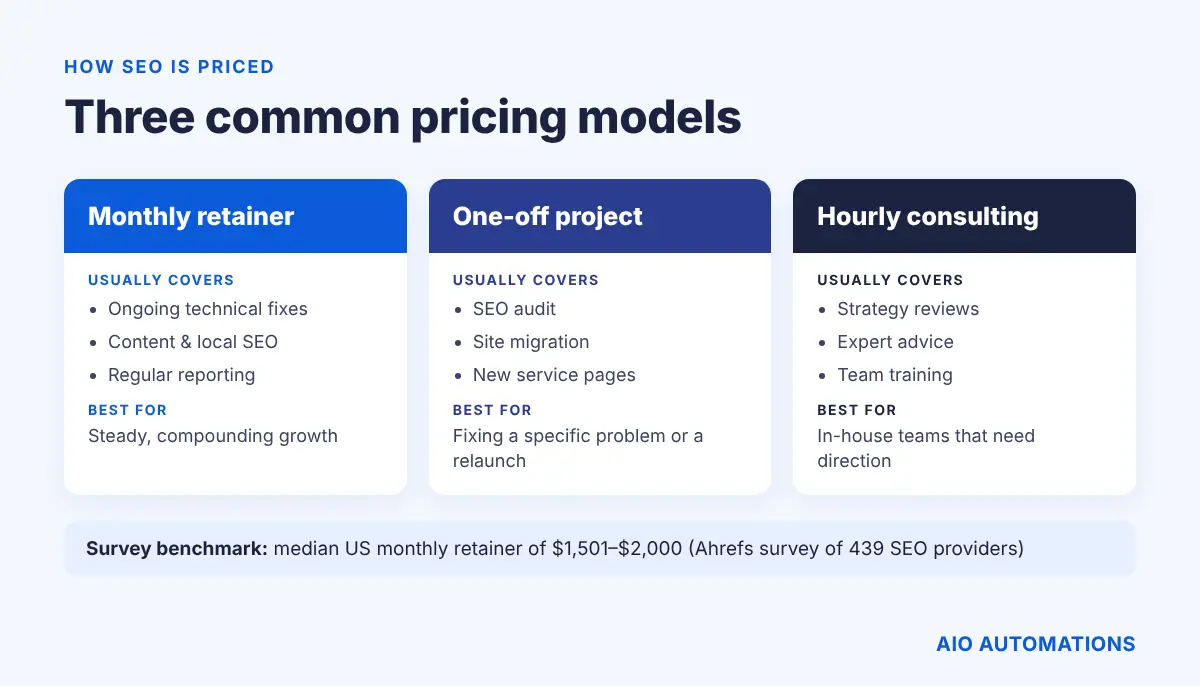
You will usually see SEO priced in one of three ways:
| Pricing model | What it usually covers | Best suited to |
|---|---|---|
| Monthly retainer | Ongoing technical fixes, content, local SEO, and reporting | Businesses that want steady, compounding growth |
| One-off project | An audit, a site migration, or a set of new service pages | Fixing a specific problem or preparing for a relaunch |
| Hourly consulting | Advice, strategy reviews, or training your in-house team | Teams that can do the work themselves but want direction |
What does “affordable” really mean?
When people search for an affordable SEO agency, they usually mean “good value,” not “cheapest.” A very low monthly fee often means very little actual work: an automated report, a few directory listings, and not much else. Affordable SEO services for small businesses should still include a real person reviewing your site, a clear plan tied to your goals, and reporting you can understand. A useful test is to ask exactly how many hours, pages, or tasks the fee covers each month.
Is a free SEO consultation worth it?
Yes, as long as you treat it as a two-way conversation rather than a sales pitch. A useful free SEO consulting session should leave you with something you did not know before, even if you never hire that provider. By the end of it, you should have:
- A plain-English view of the biggest problems holding your site back.
- An idea of which searches are realistic targets for your business right now.
- A sense of how the consultant thinks, communicates, and measures success.
If all you get is a generic PDF and a pushy follow-up, that tells you something about how the ongoing relationship would feel.
Questions to ask before hiring SEO services for small business
Google publishes its own guidance on whether you need an SEO and how to choose one. Building on that, here are the questions we suggest every small business asks before signing up for professional SEO consulting services:
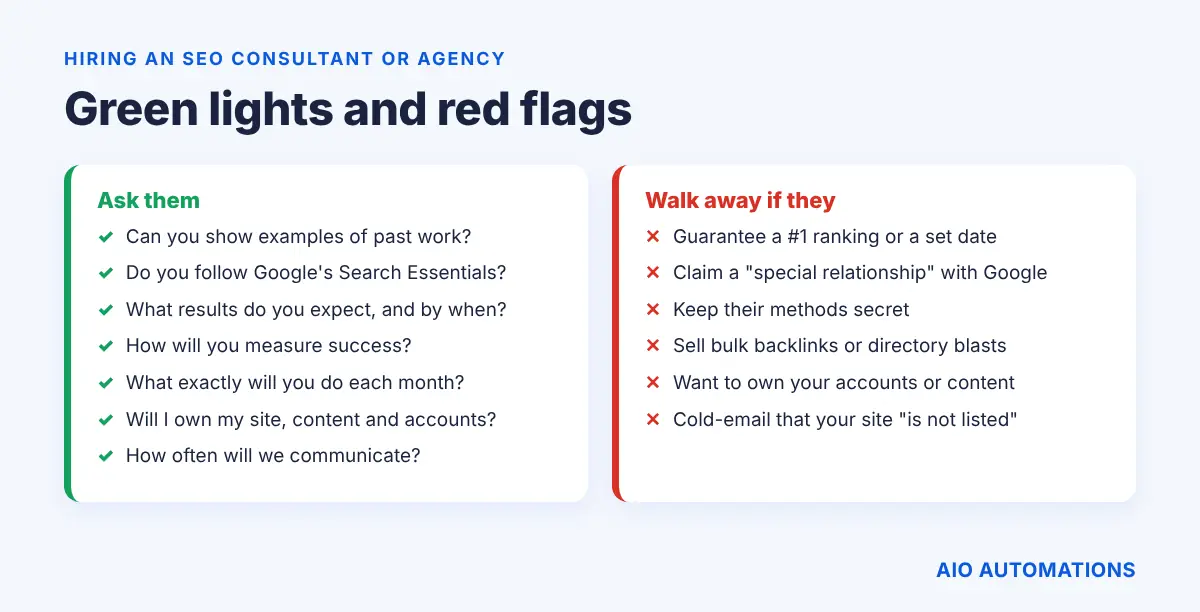
- Can you show me examples of past work? Ask for real examples, ideally in a similar industry or market, and what changed as a result.
- Do you follow Google’s Search Essentials? The answer should be a clear yes, with an explanation of what that means for your site.
- What results do you expect, and by when? A good consultant will give a realistic range and explain what it depends on, rather than a single promise.
- How will you measure success? Look for leads, calls, and sales, not just rankings or traffic.
- What exactly will you do each month? You should be able to see a list of tasks and deliverables.
- Will I own everything? Your website, content, Google Business Profile, and analytics accounts should stay in your name.
- How will we communicate? Agree on how often you will hear from them, and whether they will explain every change they make.
Red flags when choosing SEO services for small business
Google is direct about this: no one can guarantee a number one ranking. Be cautious with any provider who:
- Guarantees a specific ranking or a top position by a set date.
- Claims a “special relationship” with Google or offers a “priority submission.”
- Will not explain what they are doing, or calls their methods “secret.”
- Sells large bundles of backlinks or directory submissions.
- Wants to keep ownership of your content, website, or accounts.
- Sends unsolicited emails saying your site “is not listed” on search engines.
Shortcuts like these can lead to penalties that take far longer to fix than they took to cause.
Ask us these questions directly
We offer a free consultation to understand your needs and recommend the right solution. Bring the questions above and ask us directly.
Book a Free ConsultationRequest a QuoteHow AI search is changing SEO for small businesses
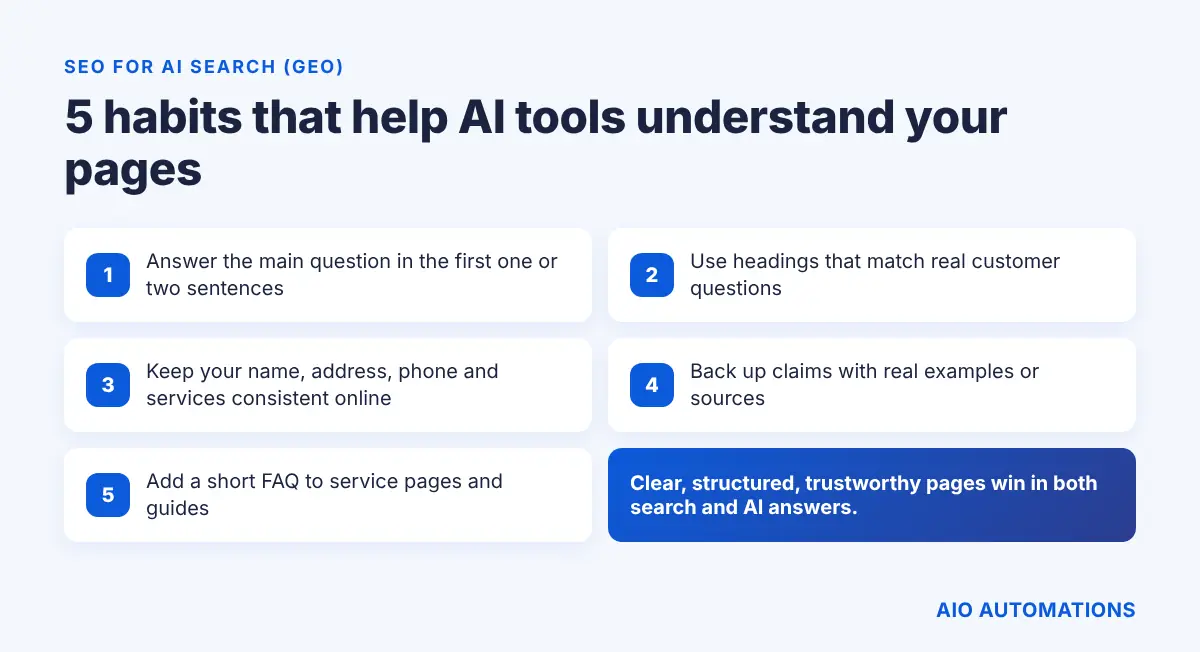
More people now get answers from AI tools and AI-generated summaries at the top of search results. This is often called generative engine optimization, or GEO. The good news for small businesses is that the basics have not changed much. AI systems still lean on pages that are clear, well-structured, and trustworthy.
A few habits help your content get understood and referenced:
- Answer the main question near the top of the page in one or two plain sentences.
- Use descriptive headings that match the questions customers actually ask.
- Keep your business name, address, phone number, and services consistent everywhere online.
- Back up claims with real examples or sources instead of vague superlatives.
- Add a short FAQ section to service pages and guides.
How long does SEO take to show results?
SEO is a medium-term investment. Quick technical fixes can show an effect sooner, but rankings for competitive terms usually build over months, not weeks. How fast you see progress depends on your site’s starting point, your competition, and how consistently the work is done. If you need leads this week while SEO builds up, pay-per-click advertising can fill the gap, and the data from paid campaigns often helps you choose better SEO keywords.
Choosing SEO services for small business: DIY, freelancer, or agency?
- Do it yourself if you have time, a simple local business, and are happy to learn. Start with your Google Business Profile and your core service pages.
- Hire a freelancer if you need help with one specific area, such as content or technical fixes, and can manage the project yourself.
- Work with an agency if you need several skills at once (technical, content, local, and reporting) and want one team accountable for results. Some agencies also offer wider digital marketing services. At AIO Automations, for example, SEO sits alongside PPC, content marketing, social media marketing and email marketing.
Whichever route you choose, the questions and red flags above still apply.
How AIO Automations approaches SEO services for small business
Our professional SEO services are built around six areas: customized strategies, keyword research, content creation, on-page optimization (including meta tags and page speed), data-driven reporting, and ethical, long-term SEO practices. For businesses that depend on nearby customers, we also offer local SEO, including Google Business Profile optimization and localized keyword strategies.
SEO and PPC are offered on monthly plans, and we offer a free consultation to understand your needs and put together a customized plan. You can request a free SEO audit or get in touch with our team, and our FAQ page covers common questions about pricing, the industries we work with, and ongoing support.
Frequently asked questions
Are SEO services for small business worth it?
For most small businesses, yes, especially when customers search online before buying. SEO keeps working after the content is published, unlike ads that stop when the budget runs out. It works best alongside a website that converts and a process for following up on leads.
What is the difference between an SEO consultant and an SEO agency?
A consultant mainly advises and plans, and may leave the work to your team. An agency usually plans and carries out the work, covering several skills such as technical SEO, content, and reporting.
Can anyone guarantee first place on Google?
No. Google states that no one can guarantee a number one ranking. Treat any such promise as a warning sign.
What should a monthly SEO report include?
At a minimum: the work completed, changes in organic traffic and rankings for target keywords, and the number of leads or conversions from organic search, along with the plan for next month.
Do I still need SEO if I run paid ads?
Paid ads and SEO do different jobs. Ads bring traffic quickly while you pay for it; SEO builds visibility that lasts. Many small businesses use both, then shift budget as organic results grow.
Ready to get found on Google?
Get a free SEO audit or schedule a meeting with our team to talk through your goals.
Get My Free SEO AuditSchedule a Meeting